


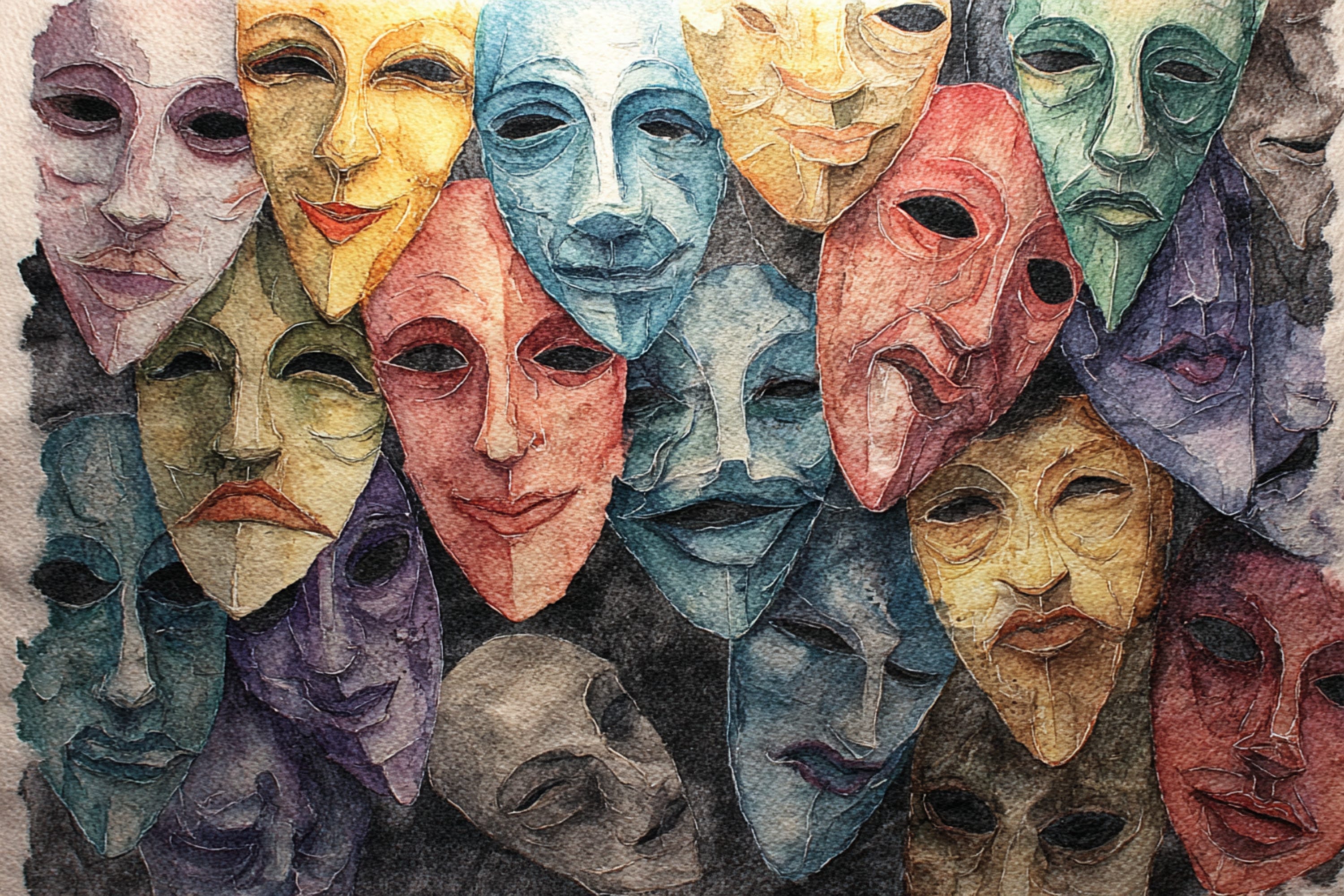
You have heard it said: be yourself.
But how do you do that?
You cannot simply be one person. In the words of Walt Whitman, “I am large. I contain multitudes.” You are many faces in one body. The faces only you know. The faces your colleagues see when you walk into the office. The faces a trusted witness helps you unveil. The faces only your son can know. Sometimes this leaves you feeling like a mask factory, wearing different yous based on whether you’re presenting in a boardroom or laughing with your oldest friend or chatting up the Uber driver on one occasion and sitting there quiet on another with your headphones blaring, or singing your daughter to sleep when she doesn’t want to sleep and then reading her that bedtime story for the hundredth time featuring Puffin Rock characters that you know does the trick.
Good. Don’t get rid of all your faces, don’t try to deconstruct them until they make perfect sense. Because you can’t. There is no sorting all your ways of being into a clean persona. There is no whittling them down until they are one, quantifiable you. Instead, hear them. Accept them. Share them. Make your many selves visible, and it will help you and those around you in ways that continually surprise.
Sharing your story makes you visible. The good parts. The bad parts. The everything-in-between parts. And we need them all.
If you withhold who you are, it is a selfish act. You may have been taught the opposite: don’t overshare, don’t make yourself out to be too important, don’t take up space. Sharing your real story does not make you an egomaniac. When you offer yourself in it many forms, you gift another the chance to witness you, and inspire them to share more of themselves. If you withhold who you are, you contribute to a cultural milieu where people skim along the surface of life. Letting yourself be seen might mean you prevent someone else’s private collapse, lifting them from it without realizing that’s where they were headed.
Sometime ago I sat with my friend Samir and told him the messier version of my life story. The window in my room was cracked and the rain was drizzling on your typical Pennsylvania spring day. Drops of water formed a small pool on the sill. There was a turn in my chest, a sense that this was the time and place to offer more of me. I could have ignored that. I didn’t. He listened. He was spacious. He was Samir.
And I learned, again, through this small act of courage, that I am not alone. There are eight-billion people on this planet and many of us are walking around with splintered selves we wish could be reconciled. But the first step to reconciliation is remarkably simple and repeatable: let yourself be seen.
You can’t know in advance what will come back when you share your story with others. Some may not pay attention, some may talk over your story with theirs, some may dislike the scenes you’ve volunteered, some may offer advice, others may radically witness you. Remember this: your responsibility is to practice the courage to see what comes back when you share with others, but what comes back is theirs, not yours.
Once you have let yourself be seen, your many selves will not dissolve. Reconciliation is an act of making peace with your masks, which is an ongoing practice. You aren’t going to figure yourself out, this life out. You are too wild and complex and magnificent, like an untamed forest you’ve been blessed to traverse. Some of your paths are proven, some used to work but now have grown over. Bring your machete to carve out a new path because you will need it. And as you make your way as only you can, you might someday discover who you really are. Which is to say, you will realize you are not all you cracked yourself up to be, and—always and—you are more than you think yourself to be. An unnerving, magical paradox.
In the sprawling forest of your life, you will meet self-doubt. You will experience suffering. These are not your enemies, but friends.
Jesus taught us to take part in his suffering in this life. Meaning there is plenty of shit to go around.
Some of us get a big pile of shit. Some, a small pile.
Jesus had a big pile of shit. He was crucified on a cross. I think that qualifies.
There is a Tibetan Buddhist meditation practice called Tonglen, where you are invited to inhale all the bad in the world and exhale only good. It sounds like it shouldn’t work that way but it does. Things in life often work that shouldn’t, like sixty-trillion cells dancing inside your body right now, fastening together your muscles and bones, pumping blood from your heart to these strange finger-things you have allowing you to cup the face of your beloved and form sounds like “I love you” and they know what you mean and you taste their lips and inhale their sweet stale breath, and then you look up and glimpse the colors yellow-red cascading down from a booming star in the sky that is rising and falling on repeat every day the same way your chest rises and falls every few seconds and it’s happening for eight-billion people on this big greenish-blue ball blasting through something called space and time to the middle of nowhere and it all matters and no one can explain why. Life is a miracle and you are a miracle, weaving in real time your unique threads as part of its greater, majestic tapestry of everything.
So, if you find yourself suffering from the pile of shit that has been gifted to you, loathing some of your masks, smile softly, and for longer than you want. Because your work in this life is not to further spread suffering around, casting it onto others when the going gets tough—to live in fear of being seen.
Rather, breathe in the difficult memories, the many masks you wear, the purpose you don’t know yet, the tragedy you just heard on the news, the weary eyes sitting next to you on the bus. And breathe out. Breathe out what’s good. Breathe out your real story. And watch it spread slowly, slowly, and slowly still, like a delicate, unstoppable wind to the far corners of the earth.
Until the next cast,
Jordan
Inspired by conversations with Samir Selmanović, Rafael Candelaria, and Jo Green.
In the waiting, we become who we are. More prepared for what might want to be reeled in. Out here, we’re fishing the universe together.
thoughtworms are hooks for aliveness, short casts into the deep.
innersparks are essays that keep the light, long fires for a long night.
offlines are composed without internet from memory and attention, honest on purpose.
Here, we return to Ourselves, again and again. Reminded we are stardust burning in the darkness. The darkness cannot overcome us.
All of my work is in service of ushering in a new renaissance. Historically, renaissances have preceded social renewal and needed revolution, the inner work before the storm, the slow clearing that helps us see what we’re building toward and what we’re willing to march for.
To read every entry I write, you can upgrade to a paid subscription. Or become a renaissance patron, helping fund the books and seed Epic Ordinary’s Change Lives Fund.
Samir and I built Your Epic Ordinary Life for people ready to say aloud what they’ve been carrying, a guided memoir experience with someone across from you who knows how to listen longer than is comfortable. It begins with An Hour to Be Seen. You talk for an hour. Within two days you hold a one-page portrait of your life, written by a human who actually heard you. The truest way to start.
Thank you, Jordan, for all the colorful identities that make us who we are!