
settling in for the long night
what julian of norwich can teach us about descending within
I zipped my black puffer jacket and stepped off the porch into the air. It was cold, not bitingly so, yet I felt its promise. My knees stiffened as a I moved, thirty-six and already negotiating with cartilage. Frost thinly layered autumn leaves like sugar on glass as they crunched beneath my feet. I walked the long winding road into the woods, past the tree line, out toward the dairy farm where brown-spotted calves and their mothers raised their heads in slow bovine curiosity, then returned to their chewing once I passed. My knees and the rest of me loosened as I plodded along into the gray of evening. The light felt bleached of warmth and the sky hung low, like wet wool stretching across the trees. Surely you know this faceless weather. How it can numb your fingertips before you notice, settle in your lungs like a damp fog, where every exhale turns visible, and every inhale reminds you it’s going to be like this for a while.
This time of year, it takes effort to layer up and step outside. The sun disappears earlier each day, and some part of me wants to follow it. This is the season when I start searching flights to Florida or wondering if there’s still time to slip away to Spain. Some years, I go, boarding a quick flight thousands of miles away to trade one season for another. A kind of luxury, yet I am no longer sure I want to indulge that reflex so easily.
When speaking with two friends this past week, each shared how they were taking a different approach to winter this year. Anastasia was looking forward to settling into her “den” in Colorado for the season. Johnnie said he would welcome the shortening of daylight in Cambridge and mirror nature’s rhythm.
They made it sound almost sacred. Winter as something to honor, not merely endure.
I paused, as that’s not how I’ve known winter. I’ve mostly treated it as something to duck. Slip past. Schedule my way around. For the gray makes me solemn. And the cold makes me restless. Still, I’m listening to them now, because something in me has sparked. Something in me is wary of running toward warmth like it’s a god-given birthright.
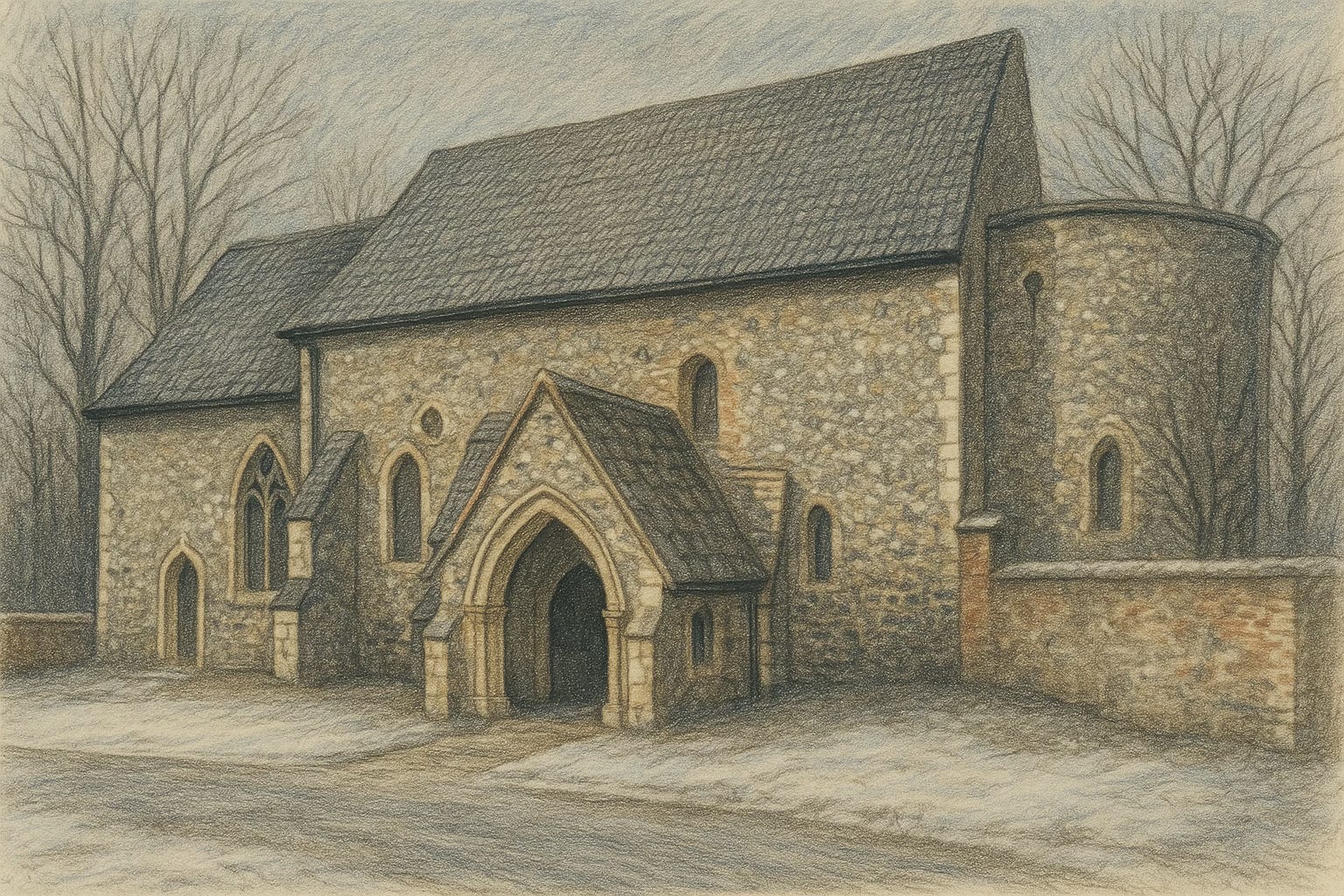
Over the last several weeks I’ve been reading the Showings of Julian of Norwich. She was a 14th century mystic and the first woman whose writings were presented in what we now call English. Remarkably she had such a disregard for her own ego that we do not even know her real name, as she never signed it at the end of her writings. “Julian” was the name of the church where she asked to be enclosed in an anchor-hold—a small stone cell built against a church wall. She chose to live inside there for decades, with only a window to the sanctuary and another to the street, no door. Yet she did not choose this home as self-inflicted punishment, or end up going mad. Something else happened. She descended within.
Julian once wrote, “God is not outside.” And while she meant this in a mystical sense—that there is no separation between the divine and the created—I’ve been thinking of it another way. If I can’t go outside as easily, what might I find within?
What if winter is not an obstacle, but an architecture? What if settling in is not resignation, but formation?
I am wondering now if winter might be an anchor-hold for those of us who’ve often regarded it as a mood-killer. Maybe it could be a context to lean into rather than a season to shortcut. An opportunity to embrace stillness.
Writing in the silence between stone, Julian described her understanding of the human soul: it was “oned” with God, united by a knot so subtle and so mighty that in it we are made endlessly holy. While that may not be language we use now, something about that image—being knotted into the divine, bound not by pressure but by presence—stimulates me.
If I can’t see the sun, or travel to chase it, can I trust that I am still wrapped up in something radiant?
We all know what it is like when the sun hits our faces. We come slightly more alive. It is one of the most liberating sensations: to feel a star light us up, warmth stretch across our achy skin, thaw us out. And yet in some seasons and places, nature seems to be telling us, “You cannot have sun whenever you want. You cannot be warm whenever you’d like. In the gray and in the dark, will you still come alive?”
While our choice to spread wings and fly to Florida or Spain or an easier pasture to flee discomfort may not be a failure of spirit, it might denote restlessness. Yet to Julian, even that restlessness would be “behovely,” as she put it in her Middle English.
“Sin is behovely,” she wrote. A word that means “necessary, appropriate” or “part of the pattern.” In her world, sin or failure wasn’t a problem to be solved but a path to tread and learn from—a provocative idea for our time, let alone hers.
Julian believed that nothing—not restlessness, not doubt, not even sin—could separate us from God in the slightest. She said unfailing union with God— “oneing”—was not only real, but the truth behind all appearances. That the love of God creates such a oneing that no person can be separated from another. That in God’s sight, one person is all people, and all people are in one person.
Whether or not you believe in the divine, what kind of winter might it be to believe that even in the most withdrawn and quiet months, you are still bound to everyone, everywhere?
Honestly, I’m not settled in yet. I’d love nothing more than to shoot off to a merrier terrain. Maybe I will. But I’m circling the idea of an anchor-hold. Perhaps this winter will be less about getting through and more about being reshaped by its starker contours.
Maybe, like the anonymous author from Julian of Norwich, we don’t need to flee our enclosure or always seek the kiss of the sun. Maybe, instead, we are being invited to stay long enough to see it is not the sun we are missing, but our own glow in its absence. It is there, whether our name is remembered or forgotten. Our light burns within the long night.
Until the next cast,
Jordan
In the waiting, we become who we are. More prepared for what might want to be reeled in. Out here, we’re fishing the universe together.
thoughtworms are hooks for aliveness, short casts into the deep.
innersparks are essays that keep the light, long fires for a long night.
offlines are composed without internet from memory and attention, honest on purpose.
Here, we return to Ourselves, again and again. Reminded we are stardust burning in the darkness. The darkness cannot overcome us.
All of my work is in service of ushering in a new renaissance. Historically, renaissances have preceded social renewal and needed revolution, the inner work before the storm, the slow clearing that helps us see what we’re building toward and what we’re willing to march for.
To read every entry I write, you can upgrade to a paid subscription. Or become a renaissance patron, helping fund the books and seed Epic Ordinary’s Change Lives Fund.
Samir and I built Your Epic Ordinary Life for people ready to say aloud what they’ve been carrying, a guided memoir experience with someone across from you who knows how to listen longer than is comfortable. It begins with An Hour to Be Seen. You talk for an hour. Within two days you hold a one-page portrait of your life, written by a human who actually heard you. The truest way to start.


