


This is the opening of a novel I have been writing for more than a decade, The Boy, the Truther, and the Looking Glass. It is the book closest to me, the one I have carried longest and shown least. I wanted you to be among the first to read it.
Here is the prologue.
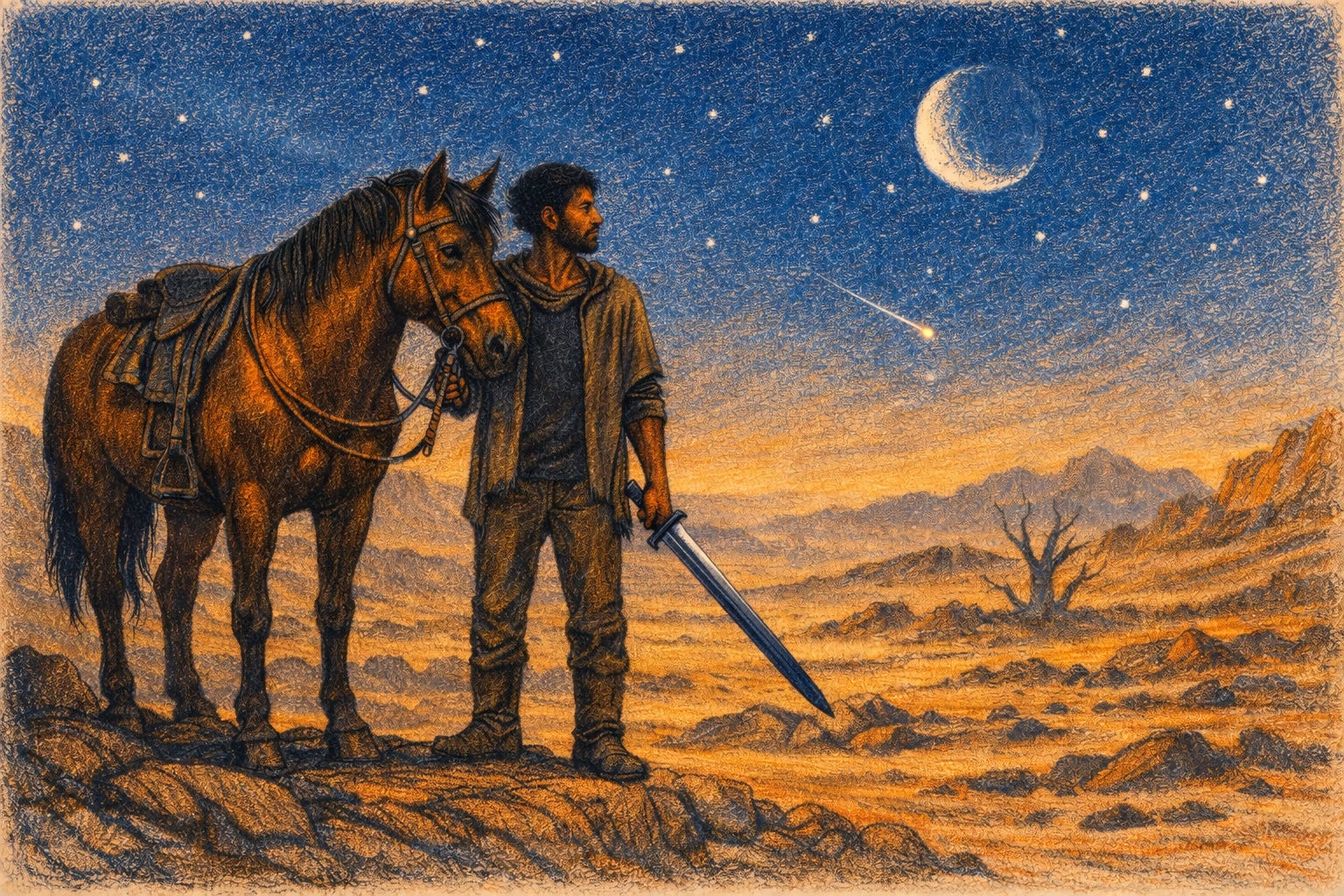
Her sons came at first light.
She had been laboring through the night, alone in the small ground-floor apartment at the end of the lane in Happy Valley, with two rooms and a kitchen, a stain on the wall where a garden shelf used to be, a hook above the bed where she had hung something she could no longer remember, sniffing the mint she had crushed between her fingers that had come from a clay pot on the windowsill, the smell helping her bear what could not be borne. The fever was on her again, foaming along her gums just as it had these last weeks whenever she worked too hard. Outside the small window, the lane was quiet. Apart from a neighbor’s footfall in the hall, nothing. Five years past the fall of Truman and the dust had already taken the sills, the corners, the small framed photograph beside the bed. First light came through the window in a pale slant and the particles hung in it like something not yet fallen. The smell of the mint was still in the room when the first head crowned. A small voice broke open the air for the first time. A strong cry.
He wanted to come.
The second was not far behind and came easier—second children sometimes do—but the fever rose in her as his head appeared and her vision narrowed at the edges and she thought she heard herself singing, and she had sung him through these nine months, but she wasn’t singing now and he came and he was quiet, his eyes closed, his small chest rising and falling.
She held them both against her chest, two small warm bodies, as the room blurred at the seams.
The Title Evaluator arrived shortly after. They always arrive whenever a citizen of Thelema gives birth. Polka-dot bowtie, the spots a deep red, he pressed his round spectacles up the bridge of his nose with his index finger below his bushy brows and set his case on the kitchen table and unsheathed his stylus and stood over the swaddled pair with the concentration of a clockmaker.
He swept the stylus across them in a single pass.
The display flickered.
Then he stopped.
He lowered the stylus and adjusted his spectacles. Swept again. He looked at the readout. He looked at the babies. He looked at the readout. He looked at the fevered woman. Then pursed his lips around an unsaid word. The instrument had surveyed something it could not place. One of the two boys carried a flicker of discontentment and the instrument could not say which. The mother saw the pause. Her stomach pulled tight.
“Excuse me, Madam.” His smile arrived in his eyes a half-second before it reached his mouth. “A momentary irregularity. I will need to consult my supervisor. Nothing to alarm yourself about, I am certain.”
He stepped into the corridor.
The door clicked shut.
She held both her sons against her breasts as the fever ran up and down her arms and throbbed across her skull. She listened to his footsteps. They did not go very far. Beyond the door she heard his long exhale. The click-click-click of a stylus, on and off, then on again. Her ribs tightened around a breath she had not known she was holding. Her arms knew before she did. They drew the babies closer.
The room became quiet. It went on for she did not know how long. The fever was folding the minutes into each other.
Then there came a sound at the kitchen door, the smallest scrape of a foot on the sill. A man she had never met appeared as though he had always been in the room. Am I dreaming? A long worn thobe. Burnished boots that had walked in places she would never dare. Stocky. A little hunched, in the manner some men are hunched from carrying things no one can see. Bald with a patchy silver beard. In his eyes was a tried twinkle—a strange light coming through.
He looked at her like a person looking at someone they have been trying to find for a very long time. He said nothing.
She tried to speak, but her tongue was swollen with the fever.
He moved to the bedside without hurry and looked down at her two swaddled boys but did not move toward either of them. He simply stood, and looked, and waited.
She did not know she was doing it until it had been done. Her arms tightened, slightly, around one of the babies, the smallest motion, drawing him a little closer to her chest.
The man saw it. He moved his eyes from her arms to the baby she had drawn closer.
“This one,” he said, mostly to himself.
Her heart pounded. Then rang. Something in her chest had been struck like a small bell, and the ringing went out into the room.
He spoke to the baby then. The mother heard.
“At age thirty-three, you may save Thelema. Rely on the Titled One to guide you. But beware the cunning of his Enemy.”
He drew a folded square of paper from inside his thobe. It was old, yellowed at the edges, and whatever was on it had been written by hand, in ink someone had ground themselves.
He extended the parchment.
The fever told her not to take it, some part of her older than the fever told her not to either, and she thought of the door in the corridor and the evaluator beyond it scribbling on his stylus, and of what would happen to her boys if anything in this room could be called a Truther’s gift, and she meant to refuse.
She looked at the baby in her tightened arm, the smallest of faces around whom the room had quieted, as though the world had stopped pressing for a moment to see what she would do.
Her fingers folded around the parchment.
She took it.
The man bowed his head once. His eyes carried something like apology, something like awe, but she could not discern them because the edges of the room had started to blur. Then he was gone. She did not see him leave any more clearly than she had seen him arrive.
The evaluator returned with two of his colleagues. One of them kept sneezing in the dust. Another spoke too quickly. The first apologized before there was anything to apologize for and then they reset the stylus. It swept across the swaddled boys.
The display flickered. The readout was resolved. Starling. Net-positive. Clean.
The Evaluators consulted and one frowned. Another checked the calibration. The first made a note and offered the mother his hand, which she did not take, and said, “A momentary aberration. The instrument was at fault. Not the children. Congratulations, Madam. You have two healthy Starlings.”
She nodded.
When they were gone she lay still for a long time and the boys were still against her. Her fever was high enough now that the room was collapsing on itself. The parchment was tucked into the wrappings of one of the babies, in a place no evaluator would think to search and no Theleman ever would.
She looked at the one in her tightened arm, the one the strange man with the burnished boots had spoken over. Something in him will have to stay awake when everything around him goes to sleep. She did not know what made her think it, only that the thought arrived whole, as the ringing had arrived earlier, from somewhere older than her.
She held both her sons against her chest.
She named them.
“You will be Jems,” she said, and thought of the days when the desert sands still gave up rubies and gold.
She looked at the other boy.
“And you will be Andre.” A person of his own. That much was given.
Two boys, two names, two small bodies that had come from her in the same hour. She did not yet know what would become of them. She knew only that she had drawn one of them closer with her arms, and that the man with the burnished boots had followed her arms, and that her insides had rung like a bell when he spoke.
She loved them both. She would have said so on her grave.
She loved them both.
And in the small private room of her body, she folded a piece of her heart around the one she had drawn closer, the one she had chosen without choosing, and hid it there, just as she had hidden the parchment, in a place only she knew.
All of my work is in service of ushering in a new renaissance. If you want to help support my attention in writing this book, consider becoming a renaissance patron.
Until the next cast,
Jordan