


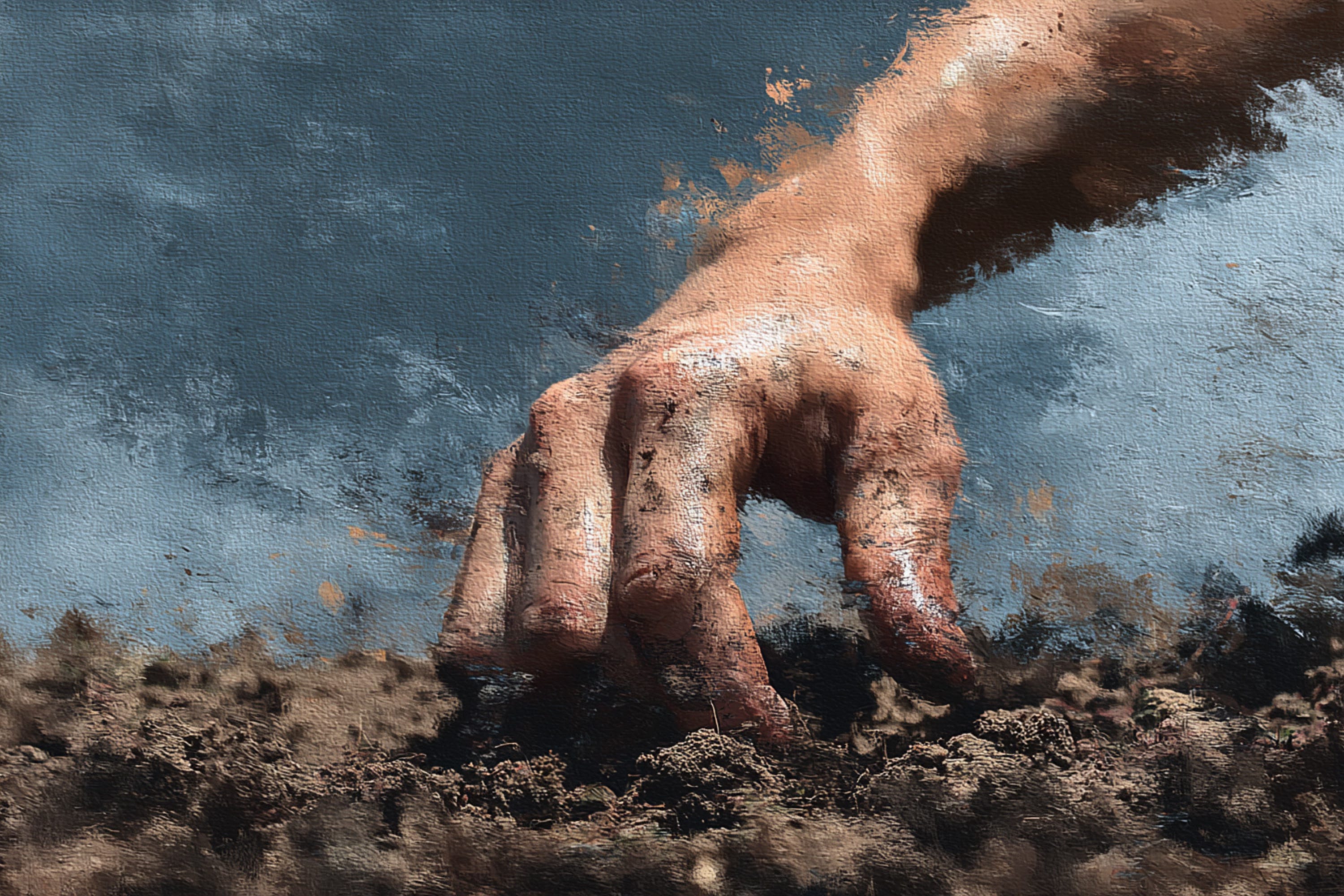
Every renaissance in history started in the dirt.
Not on a stage. Not with a speech. Not with someone powerful enough to sign it into existence. It started with a few people in a room, or a field, or a kitchen that smelled like bread and arguments, sensing that the world they’d inherited no longer fit the skin they were walking around in. And rather than wait for permission, which never comes, they began to live differently. Quietly. Almost accidentally. The way a tree doesn’t announce it’s about to bloom.
Florence. Fourteenth century. The plague had just eaten half the population. The church was cracking down the middle like a house built on sand. People were dying in the streets and the survivors were standing in the wreckage looking at each other with the particular exhaustion of humans who have just watched everything they were told was permanent turn out to be temporary. And in that wreckage, something absurd happened. A handful of ordinary people, most of them craftsmen and merchants and scholars who smelled like ink and sweat, began asking a question nobody had authorized: “What does it mean to be human?”
They started with attention. They looked at old Greek sculptures and Roman texts and saw something the medieval world had folded up and hidden in a drawer, the idea that a human being is worth studying for its own sake. Worth depicting in full. Worth the trouble of understanding. They called it humanitas. Which meant something like: the entire gorgeous mess of what a person can be.
And yet in the middle of all that death, the response that changed civilization was not grim. Boccaccio wrote The Decameron during the plague years, and it is full of humor, irreverence, love stories, dirty jokes, characters outwitting each other and falling into bed and laughing at the absurdity of being alive while everything around them was dying. The response to catastrophe was hope, fun, and wonder. What the hell? Go ahead, ask it. Because our answer might be the whole point.
Then there was Ghiberti, a goldsmith who won a competition in 1401 to design a set of bronze doors for the Florence Baptistery and spent the next twenty-one years making them. When he finished, they gave him a second commission. He spent twenty-seven more years on that one. Forty-eight years, total. Two sets of doors. The guild pushed him. But he rarely made a deadline. When asked about his process, he said simply: “I executed that work with the greatest diligence and the greatest love1.” Michelangelo looked at the second pair and called them the Gates of Paradise. They are still standing.
The social renewal came later. The political upheaval came later. The Reformation, the scientific revolution, the whole cascading avalanche of change. First came the looking, the laughing, the painstaking refusal to move faster than the work required. First came the willingness to sit in the dirt and wonder.
· · ·
Concord, Massachusetts. 1840s. A town so small you could throw a rock from one end to the other if your arm was good enough. Emerson was writing essays in his study with the windows open. Thoreau was building a cabin by a pond on Emerson’s land, because Emerson believed in the work before the work existed, and lent his friend the ground to do it on2. Thoreau wanted to find out what would happen if he stopped performing his life and started living it. Margaret Fuller wondered the same. She began holding conversations in living rooms, which was a radical act in those days for a woman, where people gathered to think out loud about things they’d been told weren’t their business3. Things like freedom. Things like what the soul actually is when you strip away the church’s wallpaper.
They called themselves Transcendentalists, which sounds like a college course you’d sleep through, but their practice was disarmingly physical. Go outside. Pay attention to the moss. Trust what you find under your own ribs more than what the institution prints in its pamphlet. They were mystics in muddy boots. They were drunk on the ordinary, and that intoxication made them dangerous.
Within a decade, these same people were among the loudest voices in the abolition movement. Thoreau went to jail for refusing to pay taxes to a government that sanctioned slavery, and from his time in the cell wrote an essay on civil disobedience that traveled across oceans and centuries4, from Concord to Gandhi’s Salt March to the Edmund Pettus Bridge, where it arrived in the bodies of people who had never read it but were living it. The attention came first. The willingness to sit with a hard question until it rearranged your insides.
· · ·
Harlem, 1920s. A million Black Americans had migrated north, carrying everything they owned and everything they’d been told they weren’t. Suitcases and scars and songs and silence. And in a few square blocks of upper Manhattan, something caught fire that no one could contain. Writers and musicians and painters began doing the most revolutionary thing a person can do. They told the truth about their lives. The uncensored version. The one with all its weight and grace and strange, unrepeatable afternoons.
Langston Hughes wrote poems in the rhythms of jazz and prayer, the kind of lines that make you put down your coffee and just sit. Zora Neale Hurston went back to the rural South to collect the stories everyone else was too sophisticated to remember. And A’Lelia Walker, heiress to her mother’s hair care empire, converted a floor of her Harlem townhouse into a salon she called the Dark Tower5, named after a poem by Countee Cullen, where on any given night you might find Hughes and Hurston and W.E.B. Du Bois and musicians and painters and activists crowded into gold-walled rooms with a sky-blue Victrola and a rose-colored piano, the whole place humming with a frequency that happens only when someone with resources sits down with people who have work and asks the simplest, most reckless question you can ask another human being: what do you need? Hughes called her the “joy goddess of Harlem’s 1920s6.” She was a patron in the oldest sense, someone who understood that the work needs talent and a room. Alain Locke called the whole thing a “spiritual coming of age7.”
Before the Civil Rights Movement. Before the marches and the legislation and the long, bloody, beautiful fight for justice. Before any of that, there was this: a community recovering its own voice. Hearing its own story. For the first time in public. For the first time without apology.
The pattern is always the same, and it is always easy to miss because it looks like nothing special. It looks like people giving attention. Cultural renewal precedes social renewal. The question “who are we?” arrives before the question “what must we do?” And the second question never gets answered honestly unless the first one gets asked with the whole body.
Christmas morning, 1956. Harper Lee, a burnt-out ticket agent for an airline, opened an envelope on her friends’ tree. Inside, a note from Michael and Joy Brown: “You have one year off from your job to write whatever you please. Merry Christmas8.” The Browns had had a good year. They weren’t rich. But they believed in her. They didn’t ask for anything back. Lee stretched that year into two, and what came out the other side was To Kill a Mockingbird, a novel that entered the American bloodstream at the exact moment the Civil Rights Movement needed it, a book about a man who stood in a courtroom and refused to look away from injustice, written because two people in New York City decided their friend’s attention was worth protecting. Emerson lent Thoreau land. Walker opened her living room. The Browns put an envelope on a tree. This is how it works. A renaissance needs artists. It also needs people who believe in the work before it exists and who are willing to make room for it.
· · ·
You know our cultural moment as well as I. We are drowning in stimulation and starving for attention. We are more connected than any civilization in history and more lonely. We have democratized information and industrialized misinformation. Our phones know us better than our neighbors do. Our algorithms have more influence over our children’s imaginations than our dinner tables do. A group of Buddhist monks recently walked 2,300 miles across the United States. When they arrived, one of them stood before a crowd and said the first thing that came to mind after four months of walking in silence: “Don’t touch your phone when you wake up in the morning9.”
Four months on the road. Blisters and rain and the slow reshaping of a body by its own faithfulness. And that was what he chose to say. He understood something most of us sense but haven’t yet had the nerve to name. We have lost the plot. We have mistaken the social feed for the living field. The way back is the oldest technology we have: attention.
Look around, and you’ll see. Something is already shifting. The biggest movie in the country right now is Project Hail Mary, a story about a schoolteacher who wakes up alone in a spaceship, befriends an alien, and saves the world through the sheer childish fun of solving problems together. Six hundred million dollars at the box office, smashing expectations. Andy Weir, the author, says it plainly: “There’s plenty of negativity out there. I sell positivity10.” Six centuries after Boccaccio responded to the plague with humor and love stories, people are responding to our times by packing theaters for the same essential gesture. Hope. Fun. Wonder. The antidote to cynicism, doom, and flippancy. They could stay at home and wait to stream it on Amazon Prime. Instead they are leaving their houses to sit together in the dark, seeking something more. We are, whether we realize it or not, becoming unwilling to be rushed, unwilling to be reduced, unwilling to let the darkness have the last word. Ghiberti spent forty-eight years on two doors. Maybe we’re beginning to remember what that kind of patience makes possible.
If you are patient, you will find the other world in this world.
· · ·
There’s a famous idea, often linked to Viktor Frankl though probably older than him, that goes something like this: between stimulus and response, there is a space. In that space is your power to choose. In that choice is your freedom11.
A renaissance, maybe even a global one, is being born in what seems like that tiniest of gaps.
Someone says something cruel to you. You feel the heat in your chest, the tightening in your hands, the old familiar surge that wants to match fire with fire. And then, if you allow yourself, you’ll notice a gap. A sliver. Barely the width of a breath. In that gap you could fire back. You could heap more suffering onto the pile of manure, and there is plenty to go around. Suffering is the one resource we never run out of. It stinks. We all have our share. Which means you could do the harder, stranger, more creative thing. You could pause. You could choose to not add to their pile of stink. You could become, in that tiny fraction of a second, something other than a reactor. You could become a creator.
That gap is the most active thing in the world. It is where every poem gets written, every honest conversation begins, every bridge gets built between two people who were sure they had nothing in common. It’s where you stop being shaped by the stimulus and start shaping the response. It is, if we’re being honest, how the whole world gets made.
· · ·
The kind of renewal we need will come the way every renaissance has always come: from a million tiny acts of attention practiced by ordinary people who got tired of waiting for someone extraordinary to save them. Because, if you haven’t guessed already, that person doesn’t exist. Or, maybe they do. You are that person. Your gorgeous, funky, flawed, regular, spectacular self.
Your work will be unglamorous. And there will be a cost. For love requires a body count. A tally of what it costs you to show up. Real, actual, felt-in-your-body cost. There is a price to creating in the gap, not going blow for blow. There is a price to telling the truth about your life to another person’s face while your voice shakes. There is a price to sitting with someone else’s pain without trying to fix it or run from it or scroll past it. Every person who ever changed the world first had to endure the unbearable luxury of seeing it clearly.
Your work may not only be about reducing suffering, either, as it seems a rite of passage for dwelling on this earth. What if your work is also to have an ease about approaching the hard things? Frankl survived the camps by finding meaning inside the horrendous. He witnessed suffering every single day. And still he found something worth holding onto, something generative, something almost, in a dark way, beautiful. Like a flower reaching through the muck toward the sky. Through the tiniest gap.
· · ·
A renaissance can be as simple as inviting friends over to have an honest and honoring conversation about what’s alive for them right now. Or what’s dead. Or what they haven’t said out loud in years because they were waiting for the right moment, which is now, which was always now. The sharing of stories. The listening that changes both people. It can look like taking manure and making clean fuel from it—both a metaphor and an actual thing humans are doing right now in actual barns. It can include not touching your phone in the morning for an hour and noticing what arrives in the silence, which will be uncomfortable at first and then, if you stay with it, the best part of your day. Or pausing between prompts when using AI to ask yourself, honestly: am I being created right now, or am I the creator here?
It can look like tending a garden—literal or metaphorical—with the understanding that the soil has to be healthy before anything grows. You cultivate a renaissance. You get your hands dirty. You wait. And at some point, if you’re giving attention long enough, you forget you’re doing anything at all and the work starts doing you.
The Italian Renaissance emerged from plague and institutional collapse. The Concord renaissance emerged from spiritual restlessness and a willingness to go to the woods. The Harlem Renaissance emerged from migration, oppression, and a people’s refusal to let anyone else define their own humanity.
What will ours emerge from?
Maybe, the gap. From your peculiar response to the nasty comment your neighbor makes. From the spacious boredom you befriend when you don’t choose Netflix for the evening. From the paintbrush you haven’t touched in years. From a few people sitting in your living room on a Wednesday night, holding a question they can’t yet answer, and being okay with that, being more than okay with that, as you feel something stir in the silence where the answers used to…
Until the next cast,
Jordan
In the waiting, we become who we are. More prepared for what might want to be reeled in. Out here, we’re fishing the universe together.
thoughtworms are hooks for aliveness, short casts into the deep.
innersparks are essays that keep the light, long fires for a long night.
offlines are composed without internet from memory and attention, honest on purpose.
Here, we return to Ourselves, again and again. Reminded we are stardust burning in the darkness. The darkness cannot overcome us.
All of my work is in service of ushering in a new renaissance. Historically, renaissances have preceded social renewal and needed revolution, the inner work before the storm, the slow clearing that helps us see what we’re building toward and what we’re willing to march for.
To read every entry I write, you can upgrade to a paid subscription. Or become a renaissance patron, helping fund the books and seed Epic Ordinary’s Change Lives Fund.
Samir and I built Your Epic Ordinary Life for people ready to say aloud what they’ve been carrying, a guided memoir experience with someone across from you who knows how to listen longer than is comfortable. It begins with An Hour to Be Seen. You talk for an hour. Within two days you hold a one-page portrait of your life, written by a human who actually heard you. The truest way to start.
Lorenzo Ghiberti, Commentarii (c. 1447–1455). Ghiberti quote and deadline detail via Gary M. Radke, ed., The Gates of Paradise: Lorenzo Ghiberti’s Renaissance Masterpiece (Yale University Press, 2007).
Henry David Thoreau, Walden (1854). Emerson’s land-lending per Walter Harding, The Days of Henry Thoreau (1965).
Charles Capper, Margaret Fuller: An American Romantic Life (Oxford University Press, 1992).
Henry David Thoreau, “Resistance to Civil Government” (1849).
A’Lelia Bundles, Joy Goddess: A’Lelia Walker and the Harlem Renaissance (Scribner, 2025). Dark Tower interior details via Refinery29, “A’Lelia Walker, Zora Neale Hurston and the Dark Tower,” December 2019.
Langston Hughes, The Big Sea (1940). Source for “joy goddess” quote.
Alain Locke, “Enter the New Negro,” Survey Graphic, March 1925. Reprinted in The New Negro: An Interpretation (1925).
Harper Lee, “Christmas to Me,” McCall’s, December 1961. Also: Literary Hub, “How a Christmas Present Gave Harper Lee the Time to Write To Kill a Mockingbird,” April 2019.
NPR, “These Buddhist monks’ walk for peace captivated Americans,” February 11, 2026. Pannakara’s phone quote confirmed in same article. Walk duration: 108 days (October 26, 2025 – February 10, 2026).
Project Hail Mary (film), dir. Phil Lord and Christopher Miller, 2026. $613 million worldwide gross. Andy Weir quote from Rolling Stone, March 23, 2026.
Frankl attribution: The Viktor Frankl Institute has noted the “between stimulus and response” quote does not appear in Frankl’s published works. Popularized by Stephen Covey in The 7 Habits of Highly Effective People (1989).
Yes, thank you, Jordan! What is not done with joy cannot last. We are at one of those flexing points in history where there will be dancing on the streets, at the first sight of letting go of the tired path we have trodden.
I’ve seen The Gates of Paradise, and now that I know the story even more incredible! “Mystics in muddy boots, drunk on the ordinary.” Jordon, your appearance is tethered to the refreshing fountain of your pen. I await with anticipation whatever book you release out there. You’re a dear blessing ❤️🙏🏼