
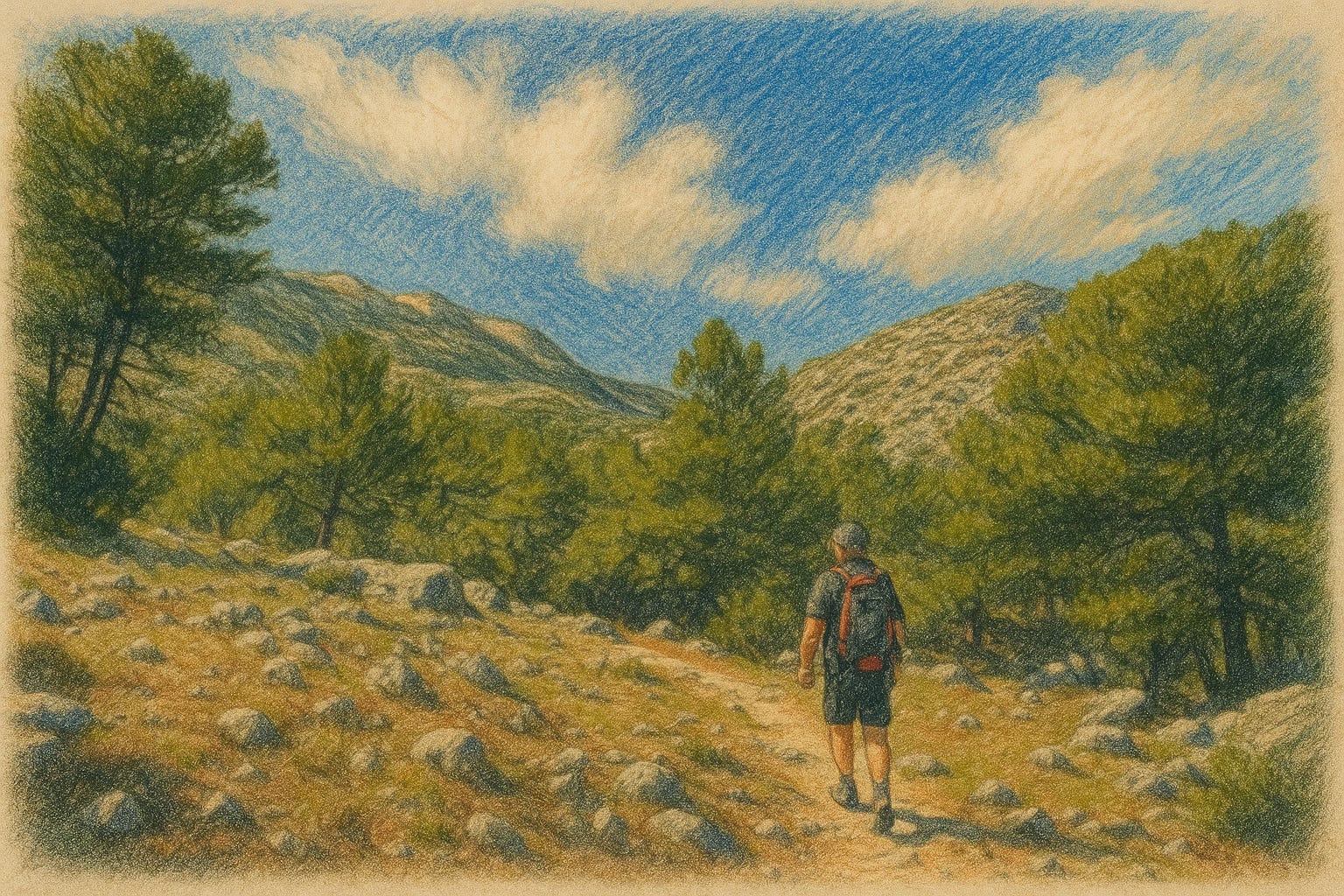
I always wanted to be one of those guys who hiked up rugged mountains, camped by nightfall next to flickering fires, caught fish with his bare hands.
Domesticated rhythms of work and life meant I never gave myself permission to try.
When I moved to Spain two summers ago after getting divorced, Rob and I set off one morning into Sierra de Gredos, a mountain range in the central region of the country.
We walked for what felt like miles through a thick, dry forest on a steady incline.
I was young and fit by most accounts, but none of that prevented my breath from feeling deranged in the heat of afternoon.
Meanwhile, Rob breathed just fine. Which surprised me (and, I admit, injured my pride a little).
Rob was pushing sixty with an average build, yet traversed the woods with the same ease that he did his frequent travels between the Saïd Business School and Arenas—not a straight-line commute.
Rob’s steps were sure and steady. He might as well have been Spanish, given how much time he had spent here the last twenty-five years. He knew the terrain. And it knew him back.
I trailed him with a kind of wistfulness, seeking solid ground amidst my life’s shifting landscapes.
Generative artificial intelligence had spurred onto the news scene at the time of our hike. As Rob and I caught up with each other, we explored the immense hype around AI, and looked for pertinent connections between it and my research into hurry.
We walked another mile uphill. “Where are we going?” I asked. I don’t recall whether I was questioning where AI was taking the human race or the overgrown trail ahead.
Then, as if he had noticed something, Rob stopped. Took a step off the beaten path. Bent his knees toward the ground. Scooped a pile of dirt into his hands. It spilled between his timeworn fingers.
“There is more complexity in a spoonful of this soil than all of New York City,” he said.
At first I didn’t know if he was being serious or hyperbolic or what this might have to do with AI. But I shut up and listened.
“Take a human body, for instance. There are as many non-human cells in you and me as our own human cells. Around thirty trillion are our own. Thirty trillion belong to microorganisms that affect health and mood. Each cell is as complex as New York City. So, if we have thirty trillion cells… that’s thirty trillion cities.”
He then pointed from the tip of my pinky toe all the way to the crown of my glistening forehead.
“From the perspective of two single cells on a relative scale between the farthest reaches of your body, they are near equivalent to the distance of any human being—right now—to the edge of the observable universe. As far out as our most sophisticated telescopes can detect: forty-six billion light years away1.
“So, you are a universe. I am a universe. ‘I am large. I contain multitudes2.’”
I took a moment to process his words, the minutiae of microbes and soil muddled with the grandeur of mountains and men and space. Slowly, I felt my chest rise and fall, recovering a steady cadence. For the first time in what felt like a long time, air deeply filled my lungs, dispersed to every last inch of my flesh. “Then we are birthing new universes all the time,” I said. “Since the cells in our body regenerate frequently.”
Rob formed a small smile. Further spun his web of thought. “To say that AI in anyway comes close to resembling that is… misleading. It massively underestimates the glory of God. A phrase that’s helpful for humility whether you consider yourself a believer or not. The idea that we are human beings and therefore can do anything is hugely dangerous. Coming into a landscape like this can help us remember that.
“For decades I’ve hiked these trails. When I come here on a day after it’s snowed, I haven’t got an idea where I am or where to go. All my cairns are covered. Meanwhile, the squirrels and mice don’t bat an eyelid.”
I noticed a cairn nearby, piled with five or six stones in semi-orderly fashion, marking out the next trail. “We think we know,” I said. “We don’t pause long enough to understand what we already have. So eager to use AI to enhance every facet of life, because that’s what everyone else is doing, because that’s how we’ll increase our margins.”
“Sometimes the problems we want to solve aren’t problems at all,” Rob said. “Which only brings about more problems.”
I looked, and the dirt had finished spilling between his fingers. He closed his hand and lowered it to his side.
“Careful. Prudence. Context. Caution,” he said.
We proceeded on our hike, and drank cold, clean water from a river.
Later, we would notice an ibex in the distance, which had already noticed us.
When we finally emerged from the forest line at a higher elevation, I witnessed great big rocky white peaks that told me a story about my smallness and their trustworthiness. We sat down on a clearing of ground, and Rob pulled a loaf of bread from his backpack, tore off pieces, and lined them with slices of smoked salmon and Manchego. We ate until full. Then each of us chose a patch of ground, laid down our tired bodies, and took siestas beneath the shadow of the sun.
All we had was all we needed.
Behold, the glory of God.
Until the next cast,
Jordan
I selected this chapter from my forthcoming book The Urgency of Slowing. I intend to publish next year. If you would like to provide feedback on chapters as I write them and commune with a small group of people from around the world making a slowing down, you can apply to join the Porch Sit Revolution.
In the waiting, we become who we are. More prepared for what might want to be reeled in. Out here, we’re fishing the universe together.
thoughtworms are hooks for aliveness, short casts into the deep.
innersparks are essays that keep the light, long fires for a long night.
offlines are composed without internet from memory and attention, honest on purpose.
Here, we return to Ourselves, again and again. Reminded we are stardust burning in the darkness. The darkness cannot overcome us.
All of my work is in service of ushering in a new renaissance. Historically, renaissances have preceded social renewal and needed revolution, the inner work before the storm, the slow clearing that helps us see what we’re building toward and what we’re willing to march for.
To read every entry I write, you can upgrade to a paid subscription. Or become a renaissance patron, helping fund the books and seed Epic Ordinary’s Change Lives Fund.
Samir and I built Your Epic Ordinary Life for people ready to say aloud what they’ve been carrying, a guided memoir experience with someone across from you who knows how to listen longer than is comfortable. It begins with An Hour to Be Seen. You talk for an hour. Within two days you hold a one-page portrait of your life, written by a human who actually heard you. The truest way to start.
I had to fact-check Rob, and what he says holds true in a poetic sense. If we were to scale an average human’s height equal to the radius of the observable universe, we could then calculate how far two cells would be from each other, relative to their size in this expanded scale, which turns out to be the Milky Way-to-cosmic-edge distance. So, not quite Earth-to-cosmic-edge. Still, the distance between two cells, one each at the farthest tip in a body, is vast when scaled up. I won’t paste the math here because Substack makes the formulas wonky, plus it’s a lot, but you can run your own calculation (with the aid of ChatGPT) if you’d like. Point is: it is not an overstatement for you to say “I am a universe.” Yes, you really are. Just a smaller universe than the one we inhabit.
“I am large. I contain multitudes,” comes from the poet Walt Whitman and could not be truer said.


